Menu
Principal Office, Houston Texas Remote Services, Texas and Florida
(by appointment only)
713.568.8600
(by appointment only)
713.568.8600 | 904.425.9046


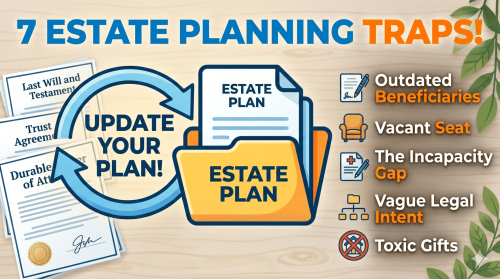
Think back to how your life was seven years ago. Your family, your finances, your relationships, and even the accounts you use have probably changed in ways both obvious and subtle. Seven years does not feel like a long time until you start making the list.
Your estate plan needs to keep up with you. The problem is that your estate plan does not update itself. Documents you signed years ago may still be legally valid, but that does not necessarily mean that they still reflect your life today or that they will work the way you expect when they are needed.
Here are seven common estate planning traps that show up over time, along with seven questions you can use as a simple audit.
Most people do not think of estate planning in terms of time passing. They think in terms of documents—something you sign once, put away, and check off the list. But estate planning is not static. It works well only when it reflects your current life, relationships, assets, and wishes. The good news is that many of these issues are easy to fix when you know what to look for.
Beneficiary designations determine who receives certain assets, such as retirement accounts and life insurance policies. In most cases, these designations control who receives the account even if your will says something different.
When you name an executor or a trustee, you choose the person who will carry out your wishes. But people age, move away, become ill, or may decline the role.
 Many important records are now online: bank accounts, email, photos, subscriptions, and accounts protected by two-factor authentication.
A good estate plan covers more than what happens after death. Many families struggle most during a period of incapacity, i.e., when someone is alive but cannot manage finances or make medical decisions.
Good intentions and family understanding do not always translate into preferred legal outcomes, especially in blended families.

An inheritance can come with complications such as liens, unpaid property taxes, expensive maintenance, homeowner association dues, or other costs that may make an asset difficult to keep.
If your plan was created years ago, it may still be legally valid. But a plan works well only when it matches your life and circumstances.
A good rule of thumb is to review your estate plan every three to five years or sooner if you have experienced a major change, such as marriage, a death in the family, divorce, a move to a new state, a new child or grandchild, a significant change in finances, or a serious health event.
A short check-in now can prevent delays, confusion, and unintended results later and give you peace of mind that your plan still protects the people you care about. Don’t wait for a major life change to find out your plan is out of date. Contact our office today to set up your review and ensure your loved ones remain protected.

Principal Office, Houston Texas Remote Services, Texas and Florida
(by appointment only)
713.568.8600
(by appointment only)
713.568.8600 | 904.425.9046
© 2026 McCreary Law Office, PLLC