Menu
Principal Office, Houston Texas Remote Services, Texas and Florida
(by appointment only)
713.568.8600
(by appointment only)
713.568.8600 | 904.425.9046


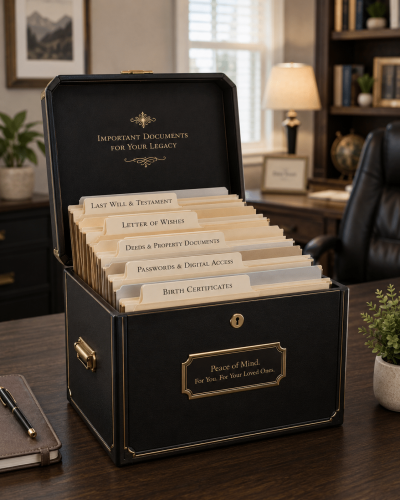
Losing a loved one is challenging enough without added complications. One way you can take some of the pain out of administering your estate is by preparing a death box, also called a death binder, next-of-kin box, or legacy folder. It serves as a centralized place to organize important information and documents in a productive, practical way, ensuring that all necessary paperwork is kept in a single location and that those who need it know where to find it.
When Jana's father passed away unexpectedly, she and her family spent months going through his things trying to figure everything out. Where were his bank accounts? Did he have insurance? What were all of those keys to? How was the business organized? Who could sign for payroll? Where was the original Will?
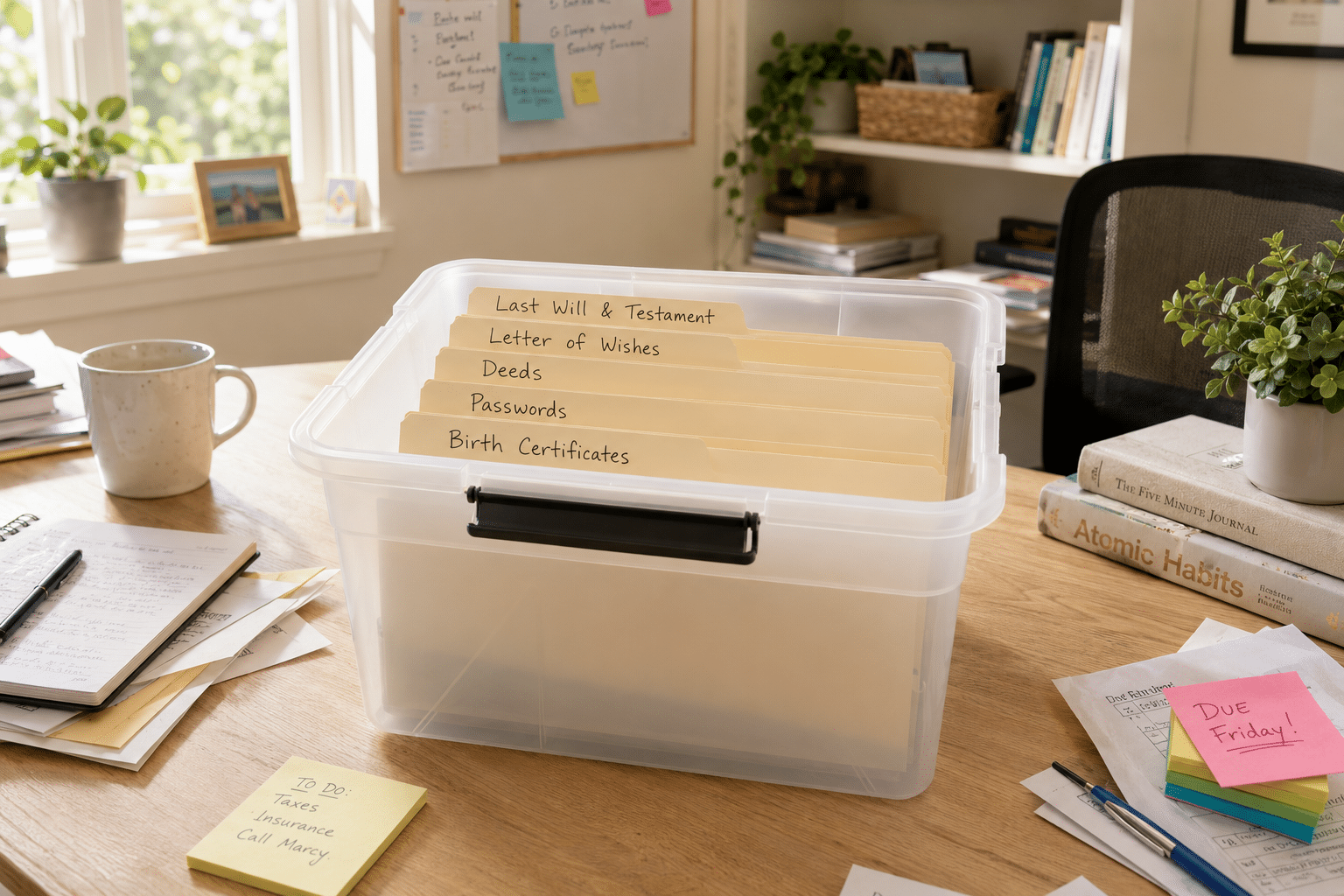 Whether it is a physical binder, a dedicated drawer, or a secure file on your computer, a death box simply holds all the essential documents and instructions needed to carry out your final wishes. (As you guessed: Jana's father had none of those things.)
To understand its immense value, consider the complex reality of grief. Following a loss, families often experience confusion, tension, and frustration alongside their sadness, making calm problem-solving difficult. Yet, from a purely legal and practical standpoint, a loved one’s passing presents an immediate administrative challenge.
Your estate plan can directly address many of the issues that may arise after you pass away. Creating a will or trust; naming beneficiaries, a trustee, and an executor; and documenting your accounts and final wishes puts you ahead of the two-thirds of Americans who have no estate plan.[1]
 But that does not mean your plan is complete. A death box, while not a substitute for a will, a trust, or an estate plan, ties a plan together in a way that may seem obvious yet is often overlooked.
If your essential documents are scattered, your family members may spend days or weeks tracking them down. Financial account details may be missing. Digital access credentials may be stored in one place, funeral preferences in another, and a copy of your will somewhere else.
Perhaps you have a letter explaining your charitable gifts, keys to a storage unit with specifically designated collectibles, or military service records that a surviving spouse needs to secure Veterans benefits—and each is stored in different places where nobody knows to look.
When your family is forced to search for missing documents, frustrations can quickly mount. The legal process can stall in court, fees can pile up, and the risk of family conflict grows. Leaving behind an administrative mess that drags on is the last thing you would ever want for the people you love.
Fortunately, it does not need to be this way. While you cannot control every detail of how your estate will unfold, proactive planning provides a steady voice during a potentially chaotic time.
Comprehensive planning begins with a thorough inventory, clear documentation, and explicit instructions. By organizing everything your family needs to settle your affairs in one accessible location—whether a physical box, a dedicated drawer, or a secure cloud file—you perform a profound final act of care and responsibility for your loved ones.
Maria Fraietta created the Nokbox (next-of-kin box)[2] after her father passed away, leaving her and her brothers to navigate a chaotic scavenger hunt for his documents, accounts, and property across multiple states. Fraietta and her brother spent hours guessing passwords; digging through their father’s phone and laptop; searching boxes, filing cabinets, and closets for bank statements and credit cards; and tracking down physical assets—a camper in one state, a boat in a second state, and the keys to his golf cart and snowmobile. As a result, she developed a simple kit to hold essential end-of-life information for loved ones when they need it. Its goal is to provide a step-by-step manual for families during difficult times, turning a chaotic, months-long process into a manageable, organized system. Fraietta’s proprietary box system has color-coded categories, labeled folders, and guided checklists for organizing everything from insurance policies to pet information.
Your death box may not require this level of detail, but the following list is a good starting point for what should go in it.

Include copies of the following documents:
If original documents are stored elsewhere, specify their location. The box should tell your loved ones what exists and exactly where to find it.
Provide a full inventory of the following information:
Include account numbers, institutions, and contact information. You do not need to list passwords, but explain how access credentials can be obtained.
 Digital Assets
Modern estates extend well beyond paper files. Be sure to list the following:
Also include individual account usernames and passwords or instructions for accessing your password manager.
Include copies or location information for the following items:
These documents are often required to claim benefits, transfer property, or close accounts.
Place documents in the box that describe the following information:
The more detailed you are, the less your loved ones must guess what you would have wanted.
In addition to legal and financial records, consider including household and access information that loved ones may urgently need but not know how to find:
Such items rarely appear in estate planning documents, but they can quickly become sources of stress if no one knows what is out there and where to look.
 The Most Crucial Detail: Who Has Access
A death box can be an indispensable part of your legacy, helping loved ones get through your passing with as few frustrations and as much direction as possible.
But a death box is helpful only if the right people know it is there and how to access it when the time comes. Even an illness or injury that temporarily leaves you unable to manage your affairs can throw your affairs into disarray while you are still alive. At a minimum, one primary person (and one backup) should always know where your death box is stored and how to open it. Such people may be your executor, trustee, spouse, or adult child.
Your passing or incapacitation could leave your loved ones scrambling to locate the many pieces of your life left scattered across locations known only to you. An organized box that your loved ones know where to find turns preparation into protection. Call us today and let’s start organizing your peace of mind.

Principal Office, Houston Texas Remote Services, Texas and Florida
(by appointment only)
713.568.8600
(by appointment only)
713.568.8600 | 904.425.9046
© 2026 McCreary Law Office, PLLC